

One hundred years after famous mathematician Alan Turing arrived at Sherborne School, an inaugural conference was held to celebrate his remarkable legacy.
Turing’s achievements include breaking the German Enigma code during World War II, laying the mathematical foundations for modern computers, and pioneering the concept of artificial intelligence.
Sherborne Schools’ Turing Conference saw hundreds of young people join leading figures from science, technology, education and the creative industries for four days of discovery.
Organised jointly with Sherborne town’s Turing Project, the conference ran from 13 to 16 October to mark the centenary of Turing’s arrival at Sherborne School in 1926.
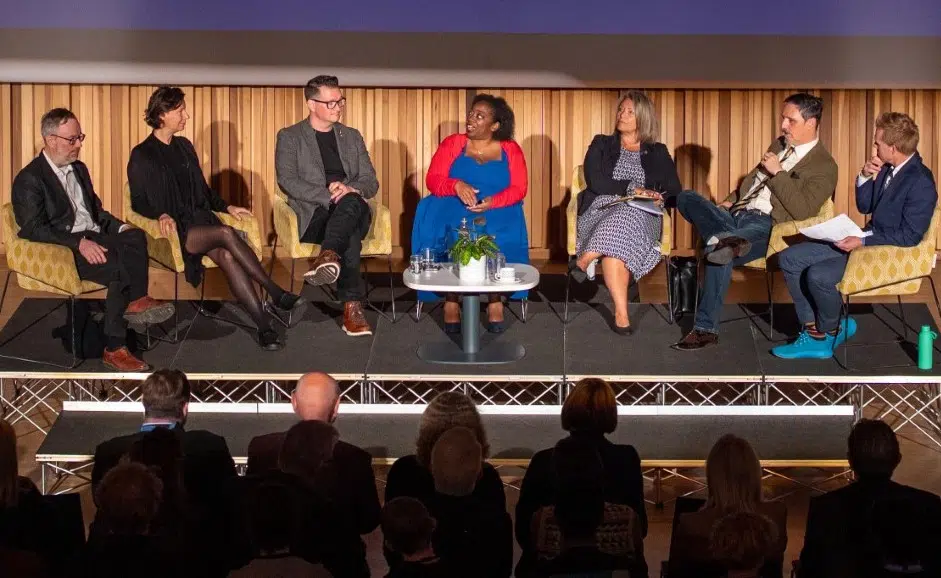
Pupils explored the curiosity, imagination and independent thinking that defined Turing’s achievements. The conference culminated at Sherborne Girls’ Merritt Centre where Sixth Form students from Yeovil College, The Gryphon School, Sherborne Girls, Sherborne Boys and Leweston questioned an expert panel on the future of artificial intelligence.
The panel included BBC comedy writer James Cary, Professor Özgür Şimşek of the University of Bath, Nick Sinnott of BAE Systems, Dr Sol Rogers of Magnopus, geopolitical intelligence adviser Suki Fuller and Professor Alison Honour, Vice-Chancellor of Bournemouth University.
Air Marshal Sir Christopher Colville introduced the session, chaired by Sherborne’s Director of Entrepreneurship, Ben Keene.
Arabella, a sixth form pupil at Sherborne Girls, said: “This was both extremely intriguing and thought provoking. Coming into the discussion I was quite scared of AI, but after hearing all the positives and all the real-world issues that have been solved by AI, I feel quite hopeful for the future.”
Earlier in the week, Sherborne Prep welcomed 300 children from neighbouring schools for workshops in coding, cryptography, robotics, creative design and problem-solving.
Dr Ruth Sullivan, Head of Sherborne Girls, said: “Turing’s legacy reminds us of the importance of curiosity, courage and independent thinking. Seeing students engage so enthusiastically with ideas that will shape their futures has been truly inspiring.”