

A partnership between Haberdashers’ Adams and Harper Adams University is inspiring the next generation of genomic scientists.
Lower Sixth students from Haberdashers’ Adams have successfully completed an exciting programme of practical molecular biology and bioinformatics training through a collaborative partnership with Harper Adams University.
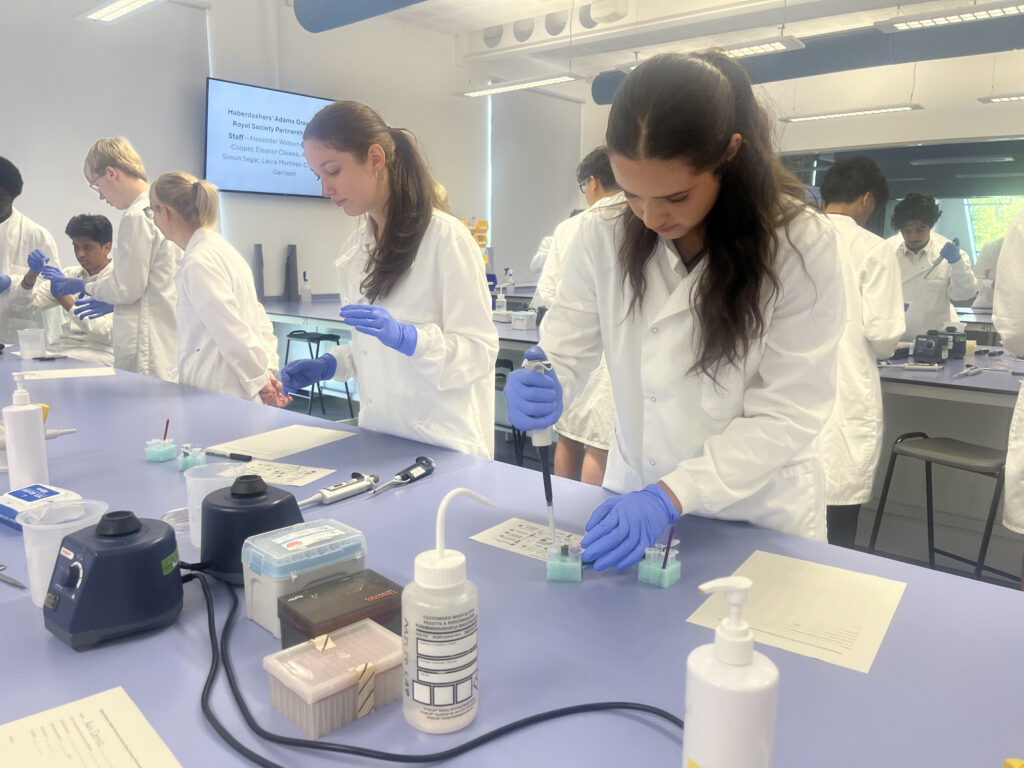
Funded by a £3,000 Royal Society Partnership Grant, the project provided students with the opportunity to experience cutting edge scientific research using techniques employed by professional researchers in plant genetics and conservation. Throughout the project, students worked within the specialist teaching laboratories at Harper Adams University, gaining first-hand experience of modern molecular biology.
Students collected leaf samples from known daffodil varieties grown at school before extracting chloroplast DNA using professional laboratory techniques. Students then assessed the quality and quantity of their DNA using gel electrophoresis and spectrophotometer-based methods, selecting the highest-quality samples based on DNA concentration and degradation. These samples were subsequently sequenced using Oxford Nanopore Technologies’ MinION DNA sequencer, allowing students to generate real DNA sequence data from their own specimens.
The project extended beyond the laboratory into computational biology. During dedicated bioinformatics workshops, students learned how to process sequencing data by trimming and aligning DNA sequences before constructing phylogenetic trees. These analyses enabled students to compare their samples with published Narcissus (the daffodil genus) chloroplast genomes, investigating how chloroplast DNA can be used to identify relationships between species and support accurate classification for conservation purposes.
Alongside the practical research, students of Haberdashers’ Adams benefited from an inspiring programme of careers talks and specialist lectures delivered by university researchers. These sessions explored the rapidly expanding role of genomics across plant science and entomology, demonstrating how DNA sequencing is being used to tackle real-world challenges including crop improvement, biodiversity conservation and species identification. By examining genuine research case studies, students developed a deeper understanding of the impact of genomics within both scientific research and industry while exploring future career opportunities in the life sciences.
Nicola Fletcher, Head of Biology at Haberdashers’ Adams, explained “This project has provided students with an exceptional opportunity to undertake genuine scientific research, demonstrating how partnerships between schools, universities and industry can inspire the next generation of scientists while contributing to our understanding of biodiversity and conservation through genomic science.”
“The project has developed students’ practical laboratory skills, computational biology knowledge, scientific communication and understanding of the complete research process. Working with university researchers and industry partners provided students with an authentic insight into higher education, collaborative research and careers within STEM.”
Dr Alexander Watson-Lazowski, a Senior Lecturer at Harper Adams University, commented “The students were fully engaged in all the practical and taught sessions during the programme, providing a fantastic learning environment. Their excitement to carry out all aspects of the programme was clear, and the insightful questions the students asked throughout highlighted their interest in the topics.”
This successful collaboration would not have been possible without the generous support of the Royal Society Partnership Grant Scheme. We would like to extend our sincere thanks to Dr Alexander Watson Lazowski at Harper Adams University for his leadership, enthusiasm and expertise throughout the project. We are also extremely grateful to the dedicated technician team and lecturers at Harper Adams University who supported the laboratory sessions and delivered specialist talks that enriched the students’ learning experience. Special thanks are also extended to The University of Dundee, who initiated the project originally, for its ongoing support and to Oxford Nanopore Technologies for supporting students’ experience of cutting-edge DNA sequencing technology.